|
| Salmon berry season ! |
[This is our second long-overdue installment of stories about our Alaskan Summer. We are slowly catching up with ourselves!]
Greetings!
After a week on the dock at Dutch Harbor, and with lots of hugs and 'see you down the way' being called out, we headed East along the Aleutian Islands in a series of short hops. One of the hardest parts of cruising is the constancy of these farewells, but one of the delights is the reconnection with old friends, often many years and and/or many thousands of miles later. This week held both.
The first afternoon, we saw what we hope will be an unusual sight: a baby whale was floating dead and surrounded by birds. We reported it to our friends back in Dutch Harbor who passed the information along to the Fish & Game folks. The cause of its death was not apparent to us.
 |
| A sad sight on the passage across the Bering Sea |
Our first stop was False Pass, so named because early explorers believed there was no route through there from the Pacific to the Bering Sea. It turns out that a channel does exit through the shoals on the Bering side, and we picked our way carefully from buoy to buoy, as their positions were different than the channel marked on the chart (and different from NOAA to Navionics charts).
 |
| Entering False Pass. |
There was a small general shore at the top of the dock, then the town was a 15-minute walk away. We were so warmly welcomed! With Fluenta secured to the dock, we walked ashore in time for the evening rummage sale at the library; the cashier at the store was also the part-time librarian. We left with full tummies (hand-made pizzas accompanied by macaroni salad with salmon roe), new sweaters (especially for Benjamin), and two bags of books (no surprise there).
As we walked along the road, people driving by stopped to tell us to us to watch out for bears (not just once, but three times!) and when we met the town safety officer (a combined police, fire, EMT officer) at the sale, he told us he had maxed out his overtime dealing with bears, so he is only allowed to respond to "predator" issues if a bear is actively trying to get into a house. About 50 people live in the City of False Pass, and another 700 people come from away (many from the Ukraine) to work at the two canneries, so there was lots of foot traffic between the residential area and the dock, and we didn't see any bears.
 |
| Playing in the park. Later we found out a child had been attacked by a grizzly bear previously in the same location ... |
 |
| We did not see any bears but this fox was curious about us. |
On the way back, the big kids ran ahead once we got to the dock, but Max, Benjamin and I stopped to talk at a fishing boat where the captain and crew were cleaning the day's catch. The captain, Ivan (in his words "a good Russian name") had been fishing these waters for over thirty years. He generously gave us a big silver salmon when he heard that we were visiting.
 |
| The fishermen are so generous |
A fishing boat had pulled in beside us while we were in town, and a flock of kids poured out when we got back to Fluenta. We invited them aboard to have a look around. It turned out that this Aleut family was thinking of selling their fishing boat and going cruising one day. I enjoyed showing people who spend so much time on the water how we had been living for the last seven years. Max had a similar tour of their boat (you can stand up in their engine room!). They suggested that we should trade boats so that we could take up fishing in False Pass (and our kids could attend the local school) and they could take Fluenta and go cruising, but we decided we weren't ready to settle down just yet!
 |
| An amazingly welcoming family. The accommodation building for the new fish plant is visible over their shoulders. |
As they left, the mom asked if the big kids would like to go salmon fishing with her teenagers (14 and 16) in their skiff, and whether Benjamin would like to come over to play with their four-year-old's toys. She also offered that we could all shower and do laundry. Imagining a typical cruiser scenario, I assumed that she meant to come to their boat, so I packed a bag for 'drinks & nibbles' and walked up the dock. It was time for a paradigm shift! They use their boat only for fishing, and they have an actual house, with a real bathroom and laundry, up the road :) We decided that the moms and the small kids would leave the dads talking engines and go up to the house. I would come back for laundry and dads in their truck.
 |
| The kids heading out fishing. |
It was 10:40pm by the time we had the kids dropped off and I was driving back to the dock (with their dogs along for the ride - the big black one in the truck box, the little grey one running down the road beside me, and my heart in my throat for fear of something happening to one of them 'on my watch'). The sun was still up and we were just starting our evening's activities! As I have mentioned, it is pretty hard to shift the four hours from Marshallese time to Alaskan time when sunset is so late. Once we had everyone back at the house (moms, dads, big kids, and little kids), we had a fantastic time sharing stories and talking about travelling. The four teenagers had seen a bear and a shark on their expedition. The dad whipped up a late dinner of burgers and French fries for everyone (much to Benjamin's amazement, as he has never seen real home-made (i.e. deep-fried) French fries on the boat) and their machines capably did what I would otherwise have been doing by hand (washing *and* drying, hooray!).
 |
| Group photo of the moms (photobombed by the kids). I am sporting my new False Pass sweatshirt, which kept me cozy, and reminded me being embraced by Aleut hospitality, for the rest of the season. |
 |
| Cruising kids and False Pass cousins. |
I was fascinated to learn about their techniques for fishing (their big boat is a seiner, so they anchor it in a bay, net the fish between two skiffs, and then bring them back to the big boat). They can be in the little skiffs from 6am until midnight; when I asked how they stay warm (as someone who gets cold just thinking about their typical conditions) the answer was, "We don't! We wear every layer we have and still expect to be cold!" I loved hearing about how the traditions are passed through the generations; our host, his sister, and his brother grew up fishing with their dad, and now their kids fish with them. It was also a privilege to hear some of their family history and to gain a first-hand understanding of the effect of the 1964 earthquake. We were even given a '4th of July bag' that contained some False Pass memorabilia - a sweatshirt, two t-shirts, and some treats - the sweatshirt was a Mom size, so I have felt enveloped in their generosity and friendship all season!
 |
| Fluenta on the dock in False Pass. The two fishing boats are owned by the same family. |
We arrived in False Pass at the height of salmon berry season. Victoria and Johnathan had gotten a taste of picking with our friends in Dutch Harbor, and they were eager to pick some more in False Pass. Their progress was a little slower than usual, however, as they had to take turns with one kid picking and the other watching for bears, even on the slopes along the main road!
 |
| More berries for jam (if they are not all eaten before) |
After photos on the dock with our hosts, and promises to reconnect if we crossed paths again, we motored out to anchor the next afternoon. There was a sense of peace that came over us at anchor: for the first time in over a month, and the very first time in Alaska, it was just our family at anchor. Needless to say, we celebrated with 'arrival chips'.
We had glorious conditions the following day - whales and sunshine! The whales we saw were very much alive - and surfaced multiple times right beside Fluenta! Victoria and I were on watch together, sailing downwind, and it was unnerving to see them come within about a boat length beside us. These whales were black and shiny, with their dorsal fin further back from their blowhole. We learned later that they were fin whales. We held our course (and our breath) and trusted them to keep track of our whereabouts! We even delayed our jibe into our next anchorage in order to give the whales a little more space :) As we approached the Shumigan Islands, we saw big groups of humpbacks feeding and breaching in the distance, in greater numbers than we had ever seen in Tonga.
 |
| So many whales ! |
We have spent a lot of time sailing where the fishing boats don't answer the radio, or don't speak English, when we call them. We are enjoying the contrast of being in Alaska: they answer calls on the radio, they speak English, they are friendly, and on nightwatches when there is more time to talk, they are curious about our travels.
 |
| So many fishing vessels but they all listen to the radio and actually respond to hails. They were all great to talk to. Unimak Pass is on the great circle route between Asia and North America so in addition to the fishing vessels, there are big ships transiting too - you can see MV San Diego Bridge (almost 1000' long) and Kyoto Star (750' long) passing south of us. |
 |
| A zoomed in view. We are close reaching much of the time in winds less then 10 kts so our course was quite erratic and kept pulling us towards the cluster fishing boats to the north. |
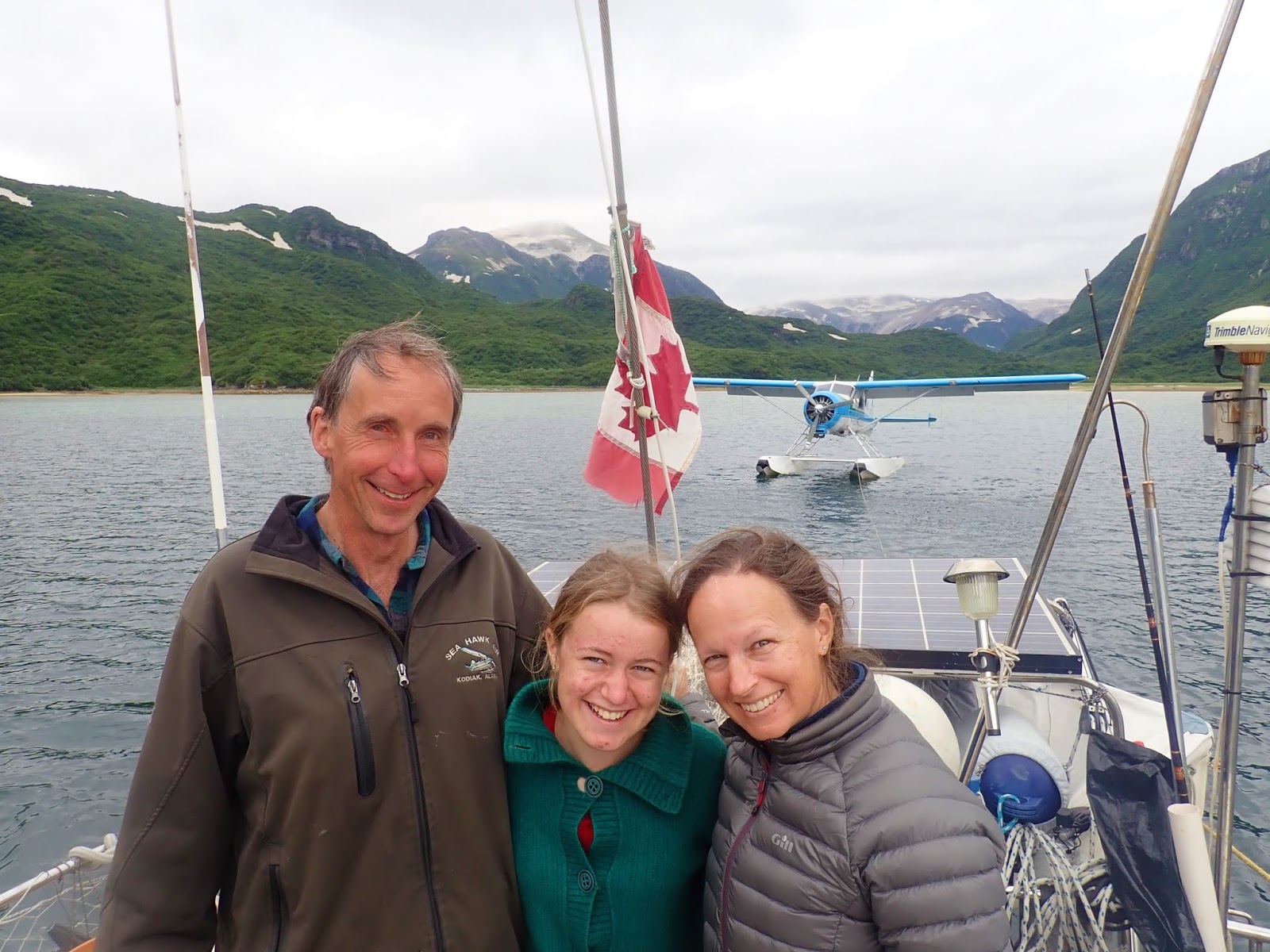
Our next stop was for a reunion with a family we had first met in 2014 when we were flying the universal baby-boat flag: diapers drying on the lifelines! Five years later, we picked up where we left off :) We had met SV Galactic in the Tuomotus (French Polynesia). Since we had last seen them, they had sailed to and wintered over in Patagonia, spent time in South Georgia and the Falklands and sailed back home to Kodiak, Alaska via Cape of Good Hope - more details at
http://thelifegalactic.blogspot.com/. Now they live in a house (!) and use their boat to do summer research projects as marine biologists.
 |
| Dinner with Galactic. A long way from French Polynesia ! |
 |
| Dinner with Galactic. A long way from French Polynesia ! |
As we arrived they were heading out in their heavy rain gear and hip waders to do some shore sampling. We quickly made plans to spend the evening together. Curious as we were to see a boat that had covered so many high-latitude miles, we were happy to host aboard Fluenta as it continued to rain all evening, and I was glad to be the one staying home! Coincidentally, both of us cooked battered fish (salmon and perch), and with the addition of rice and vegetables, and an apple crumble to use some of the last of our Marshallese apples, we had a good meal and a fabulous time catching up. With our table opened at is mid-point piano hinge, the lights reflecting off the varnished wood, and nine people sitting around its perimeter, we had a cozy space for reconnecting. We sadly said good by at midnight, and wished them well on their early start the next day. Our plans were to leave a little later and head for Sand Point Harbor.
 |
| Departing Baralof Bay in the Shumagins. Unfortunately a short visit as we would have liked to spend more time there. |
Imagine our surprise when we tied up at Sand Point and Galactic was there on the dock ahead of us! They had decided to do a last-minute logistics stop, so we had another bonus day together :) Their older boy immediately set off with his fishing rod and returned with a salmon for us. The younger boy showed up at our door and asked if the kids wanted to go salmon berry picking; even Benjamin went along to 'help'. Victoria was especially eager to fill multiple buckets so that she would have enough berries to make jam.
 |
| The Galactic crew cannot escape us that easily. We meet up with them again at Sand Point. |
Most of the fishing fleet was away when we arrived, so many of the marina slips were empty. It felt like a bit of a ghost town. A couple of days later, the vibe changed completely, as there was a pause in the season and the boats started coming back and filling the slips. It was a bit like living inside a time-lapse movie - each time we looked around, there were more boats in the harbor.
 |
| Fishing on the dock with the very proficient Galactic boys. |
 |
| Fishing on the dock with the Galactic boys. |
One of the boats I noticed was very tiny - two boys were on the walkway by the boat ramp, with a model seiner that one of them had made, and they were trying to catch a fish in a net that they had strung between the seiner and a skiff, both of which they were controlling from the dock with long lines. It was an impressive show of creativity and ingenuity.
 |
| Boats need to be tough to survive up here ! |
Sand Point has two grocery stores and a fuel dock with propane, so stopping there offered a chance to reprovision for the next leg of our journey. The fuel dock had pilings rather than a floating dock so we elected to push two dock carts with our 11 jerry cans and two propane tanks rather than to test our luck on the dock, especially since our fender boards were still deeply buried, and it was blowing enough to make things dicey. Max and I joked that the upside of walking was that it offered us a rare hour of time alone together, which was an added bonus :) We learned later that many sailboats raft up to one of the fishing boats to come alongside.
With the fishing fleet headed back to the harbor, we quickly arranged a tour of the processing facility before they were inundated with everyone's catch. We were led around the Trident plant by their Safety Officer and the Production Manager. The whole family had fun gearing up for the tour in hair nets and ear plugs, and then we were fascinated by the combination of heavy machinery and human labour that converted bins of fresh fish into racks of frozen fillets. After the fillets were cut, the bones were mechanically stripped of all remaining meat (destined for salmon patties) and it was gratifying to see how little was wasted. Processing halibut was even more labour intensive, as these large fish were filleted entirely by hand. We certainly gained an appreciation for the effort that goes into the fish that we have so mindlessly tossed into a shopping cart in the past.
 |
| The head of Safety giving us a tour. Turns out he was ex-USAF. |
 |
| With the head of production and the head of safety at the completion of our very interesting tour. It was great to see the pride in their work |
Sadly, the Trident facility wasn't given out free samples, but our tummies still benefited amazingly from our time in Sand Point - two of the fishing boats tied up beside us shared with us. King Salmon is the favourite of the fishermen, and we were given it twice! On the advice of Galactic, we baked it gently on a bed of onions and with a sprinkling of Lemon Pepper. Delicious!!
In addition to a beautiful white king salmon, the fisherman across from us gave Max a tour of their purse seiner, and then gave us a tiny knotted bowl that he had made. We may well hear from him again down the line - he has already bought a sailboat near his home in California, and has plans to leave to go cruising with his young family. His boat needs an entirely new interior, so he can build it to his own specifications, with skills of a lifetime on the water, so we look forward to hearing how his adventure unfolds. One lesson we enjoyed discussing, and that we had all learned the hard way, was the necessity to over-spec hardware and equipment on an off-shore vessel :)
 |
| One of the very friendly fishermen we met. |
 |
| and the basket he made Victoria after he found out she was interested in traditional crafts |
The end of the week brought our time in Sand Point to a close, and we set off on Sunday morning for Geographic Harbor, famous for its bears. Our passage required lots of gybing around headlands in shifty winds; we joked that we gybed more in one day than on the entire 3700nm passage from the Marshall Islands! We had expected light winds (i.e. motoring) but we had everything from 2-25 kts on every point of sail (downwind to close hauled). We suspected that the unpredictability was due to our proximity to a big mountain range. It was scenic with snow and glacier-covered mountains and the massive Veniaminof Crater visible for most of one day and Mount Chiginagak visible the following day. We had lots of puffins around the headlands and the fin whales paid us a visit again.
Love to all,
Elizabeth
 |
| This new dawn is looking rather tired. |
 |
| A screenshot of the raster chart from Dutch Harbor to False Pass. Our track was the red line. |
 |
| and from False Pass to Sand Point |