Wednesday, 14 November 2018

Letter Home - Tonga - Part 5 - Whales and More !


The final part of Liz's recent letter home:

------------------------


In writing about our season in Tonga, I have kind of saved the best for the last -- when we think of Tonga, we will always think of our encounters with the Humpback Whales.  Vava'u seems to be the more well-known as a whale watching spot, but we saw more whales and fewer operators in the Ha'apai, making it our preferred location.  The whales migrate annually from their breeding grounds in Tonga to their feeding grounds off Antarctica.  Early in the season, we had to content ourselves with using binoculars, and seeing a few whales in the distance, but by mid-August we were seeing whales regularly.  A definite buzz set in once the word spread that 'the whales are here'.  Before long we were seeing them on every passage, and sometimes even beside the boat at anchor.  On a dark, moonless nighttime passage between Vava'u and Ha'apai, Max had whales broaching on both sides of Fluenta as he passed the outer reef of the Vava'u group in the dark - that was a little too close for comfort!


During our first visit to the Ha'apai, we were encouraged by our friends Jo & Rob on SY Double Trouble, experienced divers with many whale encounters behind them, that if we were going to swim with the whales, we should do it with Darren and Nina at Matafonua.  They raved about their weekly BBQ where they showed footage taken around the resort in their lagoon and during their eight years of whale guiding.  At one of these dinners, we learned that female humpback whales will not only come back to the same region to give birth, they will generally return to the same bay, and that they were waiting for a female to return to have her third calf since they have been there.  It didn't take much deliberation for us to go ahead and book, for mid-August.  We figured that this would give us time to explore Vava'u (it did) and return at the height of the whale season (we did), and we crossed our fingers that we would have good weather for the passages up and back and the day itself (check, check, and check).  

Baby napping

With our swim date booked weeks ahead, we expected to return to Ha'apai a few days beforehand, but we had westerly winds for much of the preceding week, so we ended up with a just-in-time operation and sailed to Matafonua the day before our trip (no stress there!).  On the bright side, our swim was on the clear, calm day that fell between the strong westerly and the usual south-easterlies; gone were the grey skies and wind chop, and in its place were blue skies and a sea as smooth as glass.  We couldn't have asked for better whale-watching conditions, and we even got a good omen for the day as we left Fluenta for the beach: Benjamin (at four years old) noticed that the clouds on the horizon were in the shape of whale tails!

The boats take a maximum of eight guests who swim in two groups of four with a guide (Benjamin was a bonus along for the ride).  Many visitors to Matafonua book multi-day excursions, so we were fortunate to go out with four others who had gotten to the point that they could be choosy in their swims, which gave us a little extra time in the water.  

Our friends in Vava'u had sometimes spent as much as 2 1/2 hours motoring around looking for whales, but we were hardly in the boat five minutes when we heard the words, "Group One, get ready".  We had already approached our first mom/calf pair!  I had assumed that our family would swim with two people in each group so there was always someone aboard with Benjamin, but we were all sent together, and the staff hung out with him during the swims.  Benjamin was pretty unperturbed to be left with strangers and pretty happy to be appointed as “Boat Captain's Assistant”, which is probably testament to his unusual upbringing :)  

By the end of the day, I had lost count of the number of pairs and the amount of time in the water (four pairs/five swims?) but suffice to say that despite the tropical temperatures, by the end of the last swim of the morning, I could hardly feel my fingers enough to operate my camera, and we were pretty happy that there was hot chocolate and coffee available aboard the boat.  As an aside, there are strictly enforced rules controlling the amount of time any given boat can spend near any one whale and they only swim with whales where the whales' behaviour indicates they are not disturbed by the presence of the boat or swimmers. One of the reasons we chose to swim with Darren and Nina at Matafonua was that we were impressed by their knowledge of, and compassion for, the whales that we heard about in their briefings and saw demonstrated in their operations.


It is one thing to see the massive bulk of a mother and calf from the the boat, but it was like entering another world to view them from underwater.  What really struck me was motherhood's universal sense of stillness and serenity; the huge whale hardly moved but she kept herself and her calf together as a unit.  The babies were more active, swimming around and under her body, and then eventually even napping.  They appeared completely unbothered by our presence and just kept doing what they were doing, which was being together as one 'mamatoto' (mom and baby) entity.  The calves were intrigued by the visitors, and would sometimes swim over to have a look at us.  Perhaps the best word to describe my sensation in the water was reverence: we were graced with a glimpse into one of nature's beautiful relationships, and time seemed to stand still.

The calf eye to eye with Liz
The day after our whale swim, I asked the kids to help me make a list of the words that came to mind when they thought back on it.  Their words also give this sense that we were blessed by our encounter:  wise, massive, magnificent, gentle, stubby, slow, silent (also cold, tiring, jellyfish ... I loved their honesty).

Johnathan watching the whales - and getting cold.


Following our official swim, we enjoyed watching whales from Fluenta on our excursions around the Ha'apai, which were generally prompted by a forecast for westerly winds. We took shelter by tucking into an opening in a reef structure just south of Uoleva, where the reef itself offered protection when the winds clocked around from N to SW, and the island beside us gave protection from the SE to the North.  It was rather surreal to be surrounded on three sides by reef, with whales swimming just beyond us in the shallow waters close by; when we approached the reef, a calf who had been resting at the surface breached several times before following its mother to meander away.  The westerly shift was very light, and we woke the following morning as if we were anchored in a quiet pond; there was hardly a ripple on the water. Even while travelling cautiously and maintaining proper distances, we enjoyed the show put on by the whales :)

During a few days of calm, we anchored at Ofolanga, an island that is really only accessible during unusual weather: it is open to the trade winds, but protected from the north.  This was one of our most special spots, as we had whales swim to within a boatlength of Fluenta while we were at anchor.  The island is famous for a rock wall and caves that divers love to visit, on the western edge of the fringing reef, but there was some kind of westerly swell running, so Max did a quick recce, but the kids and I stayed in the dinghy.  We had also hoped to snorkel in a sheltered are at the NW of the lagoon (where apparently it is feasible to anchor a yacht, but we thought it was a bit small), but we ended up just anchoring the dinghy and having a picnic.  On our way back to Fluenta, we kept our eyes peeled for whales, as we had already seen at least two pairs and escorts in the vicinity; at one point we had to divert because a pair was a few boatlengths in front of us!  We hadn't seen any escorts when we went swimming with Matafonua, but in this case, even as we were drifting back in the dinghy, the large male escort swam under the dingy and surfaced beside the mom and calf to make sure we knew we were in his territory.   

A calf swims over to see us.


and the 40'+ male escort tells us we are too close by swimming very close under the dingy.

This anchorage also offered the opportunity to listen to whalesong.  Max regularly comes back from spearfishing with descriptions of the constant sonic accompaniment as soon as he was a few feet under water, and one time he even heard whales while working on the engine compartment in Mexico, but I hadn't ever heard it.  At Foa, we were behind a reef, but at Ofolanga and Nukupele, we were in a more open area, and I was optimistic.  Sure enough, when I showed the kids the old trick of putting a glass to a wall to eavesdrop (in this case, putting it to the hull on the wooden floor or directly against a bilge compartment), and we closed off one ear, we could faintly hear the ghostly sounds of the male whales singing (apparently, female whales don't sing, but males all sing songs that are recognizable around the world).  The next day, Max and I were in the RHIB, and the aluminum hull acted as some kind of tuning fork, because we could hear whalesong over the sound of the engine!  That evening, we didn't need a drinking glass: we could hear the whales as we stood on the aft deck in the moonlight.  It was a little like hearing sounds in a dream, as none of us could replicate the song afterwards, but the closest description I could come up with was that it sounded like someone playing a glissando on a cello - it was like a haunting string melody.  Throughout the day, we could look up from the boat and see the mom and calf in the near distance, slowly making their way from one side of our island to the other.

Listening for whalesong.
Another way to hear whalesong is to swim for it: we couldn't hear the sounds from the surface while we were snorkelling, but when we dove down, it was like a switch turned on and at a certain depth we were immersed in sound.  On our return from our non-snorkelling picnic trip, we actually took turns pulling ourselves down our anchor chain to listen.  Sure enough, at about six feet, the speakers turned on.  Since we were going down the line hand over hand without weight belts to about 15 ft of depth, we had great fun shooting out of the water and breaching as we let go.  We couldn't see the whales as we swam near the boat, so it was quite surreal to hear them.  Johnathan soon tired of hanging onto the anchor chain to hear the whales, so he came up with another trick - he would swim under the hull and 'stand' on the bottom of the rudder.

Standing on rudder.
Our final whale encounter was back where we had started: we anchored off Foa for two nights to say good by to Darren, Nina, and their kids, and on the Sunday morning, the mom and calf with whom we had first swum spent about an hour gently circling our boat.  Just when I thought they couldn't get any closer, the mom led the calf right in front of our bow, so close that it looked like her fins were touching our anchor chain!  Of course, that was the moment that the camera battery died.  We had spent all season looking for whales, and now they were coming to us :)  When we left the next morning to return to Vava'u and then go onwards to Fiji, it felt like we had really experienced the whales that we had come to Tonga to see.

A mum and calf swam around Fluenta for about an hour.  At one point we thought they were going to run into our anchor chain.

You will see photos of various anchorages as we collate and post them, but for the most part, we spent long stretches of time at each location in the Ha'apai, and moved around every few days in Vava'u.  

You will note that the one thing I haven't mentioned about visiting Tonga is visiting Tongans.  We found that we were either not anchored in front of villages, or if we were we were amongst large groups of boats passing through for brief visits, so we generally kept to ourselves.  When we meet people, we prefer it to be meaningful for all of us, and we don't find that we enjoy the whistle-stop tours as much.  We are hoping to meet more local people when we head north from Fiji in November.  In the meantime, we enjoyed the ladies we met at the market in Neiafu (who by the end of our Tonga season recognized us with a smile when we come for our provisions), as well as the various local folks who were working at Matafonua and Sandy Beaches.  It was a bit of an unusual season from that perspective, but with so many yachts in Tonga, it didn't seem that it would make a difference for the villagers to meet 'one more boat'.  From that perspective, I am actually looking forward to getting back off the beaten path and heading north!

Despite our lack of time visiting Tongan villages, we did take in a couple of Tongan feasts.  At the first, in Vava'u, at the "Matatongan Feast" we were surprised to look up shortly after anchoring to see our field of view taken up by a 285 foot sailboat, navy blue with a turquoise stripe.  We had been joined in the anchorage by SV Aquijo (the largest high performance ketch in the world), and were joined at the feast by the owners and 15 of their crew, along with a single hander from the US.  We had a delightful evening at the feast, not least because the crew and owners were so interesting to talk to.  The village offered a traditional menu, as well as a dancing performance by the young children from their Sunday School.  I was glad to meet some of them and learn about their school system.  

On our return to the Ha'apai, we were blown away by the quality of the dancing performance offered at Sandy Beaches by the local village.  The feasting season had started during our absence, and each Friday night, following a traditional meal at the resort, a large group of teenagers from the local high school, as well as their exuberant mothers and several teachers, came to offer a performance of traditional stories and dances.  I was especially heartened to hear that even though the mothers mostly came from a generation that felt they had lost their dances, when one teacher took it upon himself to teach the students to dance and make the traditional costumes, both the mothers and the teenagers were resurrecting their traditions.  I am not sure who had more fun that night - the dancers or the audience - as we were invited to stick dollar bills to the coconut-oiled skin of the dancers, and the whole audience got in on the act.  What a delight!  Even through we elected not to visit Samoa, in order to extend our stay in Tonga, the teacher assured us that we had had a taste of Samoan culture, as several of the dances are shared (and there was some rivalry as to where they had actually originated).  It was fun to get a taste of both countries' cultures in one evening's festivities :)


Our season in Tonga offered a nice balance of time alone as a family, time with other people, kiting and whales. It was fun for the kids to learn to kite alongside their new friends, and it was extraordinary to have the opportunity to spend so much time in proximity to the humpback whales. For this I will be forever grateful.

For now, big hugs and much love from all of us aboard Fluenta,

Elizabeth

Monday, 5 November 2018

Letter Home - Tonga - Part 4


Part 4 of 5 of Liz's letter home:

-------------------------------------------------------------
Swimming into Mariners Cave
As I have mentioned, Vava'u has a very different feeling from the Ha'apai.  The first indication that we were in a new environment (besides the dozens of boats that popped up on AIS as we approached Neiafu) was the availability of a dedicated cruiser VHF channel repeated across the entire group, complete with a morning radio net seven days/week, hosted by local businesses that cater to yachties and visitors.  There are over 40 anchorages (all numbered) all within about 10nm of each other, and there is always somewhere protected to anchor.  Everywhere we looked we saw boats going by: an average of 500 boats visit Vava'u each year, and there are also almost two dozen whale swimming operators, with over three dozen boats in the water on any given day, so all in all, it seemed much more crowded to us.  On the bright side, this did mean that there were more kid boats, and there was even Friday night racing.

One of the advertised highlights of Vava'u is the opportunity to swim into Mariner's and Swallows Caves.  We anchored at Nuku (a very pretty spot where I was also able to do some yoga on the deserted beach), packed a picnic lunch, and headed out by dingy to see both caves. The caves are similar on the inside, with lots of beautiful rock formations, but totally different in the approach: a dinghy will fit into the entrance of Swallows, while the access to Mariners is from under water, so a person must dive down and swim about 12ft to access the cavern.

Our first stop of the day was at Mariner's Cave.  We sent Max first, then Johnathan and Max, then Victoria and Max, while I 'volunteered' to watch Benjamin in the dinghy.  Finally, there was no avoiding the fact that it was my turn.  With all the time I have spent on my yoga mat in the last ten years, I knew I would be able to hold my breath for the entrance, but I had never quite gotten around to the practice swims under the keel that Max had suggested.  On the other hand, I had read on various cruising blogs that Mariner's was not to be missed, so I was not going to let either my fear or lack of preparation get in the way of seeing it.

All this made sense to me as we were planning the outing; however, I must admit that as I floated on the surface, looking at the dark and shadowy entrance six feet under the water, and considering the anemic glow from my dive flashlight, while endeavouring to do deep/steady breathing to prepare myself to dive and hold my breath, I was not having any success at steadying the hammering of my heart!  Johnathan told me that it would take 15 seconds to arrive in the cave.  When I finally got myself under the water and began stroking strongly through the dark under the entrance, counting slowly in my head, it seemed like the longest 15 seconds of my life! It also seemed like it might be my last 15 seconds! I wondered how on earth I had gotten myself into this situation, and in fact, had to remind myself firmly that "we can do hard things" (a favourite quote from Glennon Doyle), and to keep swimming.  As it turned out, having been told not to come up too early at the risk of knocking my head on an overhanging rock, I swam pretty much half way across the cave before surfacing to gasp for breath :)  Once inside, I felt a mix of the elation of accomplishment and the dread that there was no way out of the cave except underwater.  At least this time I would be swimming towards the light.  I am not sure if I was hyper-ventilating from the swim itself, from the shock that I had made it and was still alive, or from the actual sense of accomplishment, but suffice to say that it took a few minutes to get my breath back!  

Inside Mariners Cave.  Note the fog that forms as the ocean swell changes the pressure in the cavern.

While we were in the cave, the air was constantly fogging and clearing, as every wave hitting the underwater entrance reduced the air volume and raised the pressure enough to cause water droplets to form (and our ears to block); they dissipated and the air cleared instantly as the waves backed off.  We didn't have to go far for our science lesson on this day!!  My return to the surface was kind of funny:  I dove down, swam towards the light, felt a sense of relief to be outside the cave in the clear, and then noticed that I still had six feet to swim before I could actually breath because I was still deep under the water!

Liz and Johnathan on the surface while I dive down for a better picture
Once back at the dinghy, I realized that, having survived it, I didn't really want to go back into the cave.  I took this as my cue to do it again: I wanted to know (to prove?) that my first visit was not a fluke.  This time it was Victoria's turn to do a mother/daughter cave swim.  It took me just about as long to psych myself to dive for the second time as it did for the first, but after a couple of aborted attempts (not quite coordinating the dive down with the entrance to the cave), I managed to swim in and come to the surface just inside the mouth of the cave, which turned out to be much easier!  I felt kind of proud to have done something that everyone knew was outside my comfort zone, and it inspired me to consider free-diving some more (maybe even with a course).  I'm pretty sure that without diving at Mariner's I would not have heard the whale song when we returned to the Ha'apai, as I would not have swum down our anchor chain to listen.

Victoria playing with the fish in Swallows Cave.
After Mariner's, Swallows Cave was quite uneventful!  We dinghied over and anchored at the mouth of the cave, picnicking while we waited for a tour group to finish, then we all went inside, including Benjamin who, having sat out the morning was quite pleased with himself for swimming into a cave.  Swallows is famous for its late-afternoon colours, so we timed our visit for the end of the day.  In addition to the obvious features of schooling baitfish and beautiful light, Johnathan and Victoria worked together to hold the dinghy under one of the vertical outcroppings, then Johnathan channelled his inner monkey to climb up and leap off.  The water was clear and deep, so he was perfectly safe, but I had to admire his bravery, using fingers and toes to climb a good 2-3x his height up a narrow vertical edge (ie not a wall) before jumping.

Walls are of course made to be climbed ...

We spent as few days as possible in Neiafu (the capital of Vava'u) as we preferred to be out at anchor, but we were fortunate to be in town for one of the weekly Friday night races organized by a waterfront bar.  Racing isn't really my thing, but Max went ashore to see if he could crew with someone, and the result was an enjoyable evening for all of us.  There were three boats at the pre-race meeting, one of which was a catamaran with quite a big contingent.  They invited him to join them, but his eye was caught by a quiet couple in the corner who seemed a little more like his type of sailors.  In his words: "A catamaran with a massive and loud crew offered me a position but there was a quiet couple who were not seeking any crew.  I asked if I could go with them and what a good call that was.  Not only did we win - which is always nice - but the boat was really well set up and run extremely well by the husband and wife team.  Later I found out why they were such great sailors - the husband used to be the professional skipper of Steinlager II and the wife is the daughter of the late Sir Peter Blake.  Great folks.  The rest of the crew were some great Tongan guys who were good sailors and had great stories from setting up the whale watching industry in the early days.  The race flowed into a few after race beers to a full blown party ashore."  

Fluenta in the middle of the race course.  A nice evening of racing with great sailors.
 
Victoria volunteered to be our designated photographer with the 'big' camera, so she and I stayed on the upper decks of Fluenta, and watched the race along the harbour with front row seats :)  Along with our friend Paul from Romany Star, who happened to be in Neiafu for a couple of days, and whom we had previously invited to Fluenta for dinner, we had a great evening with friends both old and new at the post-race party.  [Aside: When the Romany Star visited Tonga last year, they decided to return with laptops for the highschool in Niuatoputapu, the remote group north of Vava'u, and after a year of fundraising, Paul had flown to deliver the laptops as far as Neiafu, after damage to Romany Star prevented him making the trip himself.  Another yacht took the laptops the rest of the way the following month. Hats off to the Romany Star for seeing a need and finding a way to meet it.]

-----------------

Stay tuned for the final installment shortly ...


Saturday, 3 November 2018

Letter Home - Tonga - Part 3 of 5.

Here is part 3 of Liz's letter home discussing our time in Tonga.

------------------------------


Kiteboarding at Matafonua
As you know, Victoria and Johnathan are always on the lookout for the opportunity to camp.  All they need is a few other kids and some kind of shelter, and they are happy for days.  In this case, the Matafonua kids (aged 10, 11, and 13) were given permission to use their family-sized tent, so there was no need to either unearth our pair of little tents from under the V-Berth or to build palm-frond shelters.  All five big kids (and Benjamin during the day) spent a lot of time playing and laughing (and sometimes even sleeping) in that tent.  We made sure they got fed, but otherwise we hardly saw them at Fluenta. Given that in addition to hanging out in the tent, or playing on the beach, they also had a trampoline and an an extraordinary tree house play structure, it was not hard for them to keep busy!

One of the lovely things about travelling with children is that every now and again we meet those really special people who have a unique capacity for connecting with them. Especially in an age when parents can be preoccupied and busy (and who isn't?!), meeting a grownup who makes time for a child is a powerful gift to the whole family. We met such a person in one of the guests at Matafonua. Even now, several months later, Benjamin still talks about his friend Tara, who taught him to count to five in Japanese (ichi, ni, san, shi, go), who let him teach her Minecraft, who played 'airplane' games with him on the huge beanbag chairs, who conversed with him as if he had something important to say, and who even encouraged his goofy 'photo face' when taking selfies together. As a mom watching this friendship blossom, I felt a real sense of gratitude that she would take time on her holiday to pay such joy-filled attention to a very little boy. Since she was a free-diving instructor who was interested in sailing or cruising one day, I really enjoyed getting to know her myself, too! Our paths may take a long time to cross again, but her gift of time and attention lives on in Benjamin, and motivates me to look for my own moments of connection with the children that we meet. From our hearts to yours, we thank you, Tara.


Benjamin's special friend, Tara.

Max went out for a long paddle on his SUP one morning when the wind was absolutely still and the water like glass.  While he was gone, the boat made a big shudder, with the rig shaking, as if something had bumped us.  The kids and I wondered what it could have been, but in the end we shrugged our shoulders at the mystery.  As it turned out, something *had* bumped us: an earthquake had occurred in Fiji, and we had felt the shock onboard .  It was funny to hear some of the stories when we went ashore that evening - people walking on the beach had not sensed it, but people sitting 20 ft away on the patio had felt the earth shake.  Max didn't feel a thing on the paddleboard.  Thankfully, there was no tsunami warning afterwards; I would be just as happy if this was the strongest effect we ever felt from an earthquake!


In addition to underwater photography, Darren has a passion for capturing the beauty of the area around Matafonua with his drones (an extensive collection that goes back many years). He has some extraordinary footage of the humpbacks which we loved seeing during the weekly BBQs, and even followed Max on his kiteboard one lovely afternoon (video which Max has posted to Facebook: the link is here:  https://www.youtube.com/watch?v=H1dmYFQAKZQ). Thank you Darren!


On our second visit, we arrived in time for the last week of the kiting school, so I arranged a lesson, which filled in some of the gaps in my technique/knowledge, and gave me the confidence I was looking for.  This particular afternoon was especially fun, because it was the first wind we had had in days, and given that it was Sunday, all the whale guides had the afternoon off, so the beach was full of kiters (ok, there were maybe half a dozen ...).  There is a strong current near the point at some tides, so I felt quite proud of myself when I was able to kite upwind (and away from the channel). I had my best session ever on the kite at the end of that afternoon, feeling like I was finally getting to the point that I could relax and enjoy myself.  Much of the kiting area is over the shallow coral gardens, so it was always interesting to look down when I paused to take my eyes off my kite :) Max spent most of his time at Matafonua as a tiny speck at the outer reef, playing in the waves, and practicing jumps in the areas where it was deep enough.


Dan teaching Johnathan how to kite.  Fluenta and our friends on SV Om in the background

Victoria kiting.

Having watched the instructors with one of the Matafonua kids, we realized that we had a brief opportunity to arrange lessons for Victoria & Johnathan: we had wind, instructors, kid-sized equipment, and time, so both kids did three lessons with Dan and Leonie before they packed up the school for the season.  It was delightful to see how quickly they learned with consistent lessons, the same instructor every day, and long stretch of flat sand under foot (no cockle shells in sight!!)  At the end of the week, we even purchased the 4m kite they had been using, so they could continue their progress as we travel.  We are now a four-kite, four-kiter family!


Victoria and Johnathan with their instructor Dan.

Once we both had our kiting gumption back, we felt brave enough to venture off the beaten path. The forecast of a westerly was our cue to move from Foa.  We had an extraordinary few days anchored off Nukupule Island, which we chose by looking at satellite imagery and talking to Darren, rather than by following a guidebook or someone else's waypoints . Nukupele was uninhabited and sheltered from the north and west, surrounded by a lagoon created by an atoll-like reef, and perfect for our purposes (kiting and whale watching).   I didn't exactly kite with whales, but Max and the kids were watching whales breach behind me as I kited :) I stayed pretty close to the island, but Max had a great time exploring with the kite the fringing reef that surrounded it.  It was pretty extraordinary to see whales from the boat and then go kite and see them in the distance!


Kiting at Nukupele


Soon enough, it was time to move on from the Ha'apai to spend some time in Vava'u. Choosing anchorages that were ideal for kiting helped us to narrow the field from amongst dozens of choices :)  


Our favourite spot in Vava'u was Kenutu Island.  Kenutu stands out because it is at the far east of the Group, so on the windward side, ocean swells break impressively against the steep cliff face and crash through gaps at the edge of the anchorage, while in the lee, the beautiful sandy beach offers plenty of room to play.  Nearby, a little disappearing island was pretty much the most perfect kiting spot we have found yet, with smooth white sand on which to prepare and launch, surrounded by waist deep water and a sandy bottom with minimal coral.  We could kite in any direction, regardless of the wind, and with the fringing reef some distance away, there was a beautiful stretch of flat water on which to play.  Even I liked it, and even before the kids were kiting themselves, we had a lot of fun as a family, with one parent kiting, one guarding, and the kids building and digging.  Benjamin loved the fact that he could run around the entire sand bar in about 30 seconds :)


The windward side of Kenutu
Playing at the sandbar near Kenutu.

I loved the tiny scale of the Kenutu Island: the hike up to the lookout at the top of the cliffs was only about 10 minutes!  We had just started our new Biology course during our first visit, so Victoria and Johnathan (with generous help from Benjamin) each took a 2mx2m section of the beach / tide pools to do a plot study.  I suspect there aren't too many Canadian children counting hermit crabs, sea stars, urchins, sea slugs and funny snake things (I'm not sure what they were called) in their backyards.

Fluenta at anchor off Kenutu.


Mid-season, we had a period of westerly winds in Vava'u so we were able to anchor in a spot that would usually be untenable because it is exposed to the trade winds.  Gau offered a beautiful beach and sandbar, and I enjoyed the yoga and the company of Beach Flea, but as it turned out, I didn't really like the kiting conditions (and my knee was still dodgy) so Max kited, and I kite-guarded (i.e. took photos from the beach with the dinghy ready in case he set off for the open ocean).  This was one of the more crowded spots where he kited, as there was one other kite on the water with a narrow channel and a sandbar to maneuver across :)  


Kiting in a westerly at Gau.

When we returned to kite at Kenutu for a few days before we headed to Fiji, the whole family was able to kite.  By this time, summer was over, and Canadian school was back in session, and we actually anchored about 2nm away, off Mandala Resort, for the internet we needed to stay in touch with our teachers at SelfDesign.  The kids each had a lesson with Max, progressing to body dragging with the board under their arm, and then after both grownups had had a chance to kite near the little sandbar, Max was able to kite downwind all the way back to Fluenta, while we followed him in the dinghy.  


Max had a little more of an adventure the next afternoon: the wind had picked up beyond the mid-20's (i.e. high-wind configuration, where he used my kite, Johnathan and I were ready with the dinghy, and Victoria was on Fluenta with Benjamin) when my kite bladder blew a hole and crashed just as the heavens opened.  In the midst of a squall, which limited the visibility to the point we could hardly see Max 1/4 nm away, Johnathan and I headed out through the choppy seas for the rescue.  This is why we kite one at a time!


Rescue !  A still from the chest mounted Go pro as Liz and Johnathan come out to rescue me.

All in all, we loved having the opportunity to kite in Tonga, where we could take advantage of trade-wind conditions, and hardly had to share the beaches with anyone else :)


-------------------------------------

Stay tuned for part four to follow ...

Friday, 2 November 2018

Letter Home - Tonga - Part 2 of 5

Here is part 2 of Liz's recent letter home describing our time in Tonga.
-----------------------------------------------

One of the big draws for us in coming to Tonga was the opportunity to hone our kite-surfing skills on uncrowded beaches.  I even wondered if I might find somewhere to take another lesson or two to improve both ability and confidence.  We found lots of good spots (especially thanks to our friends who cruised here several years ago on SV Estrellita  who set us up with recommended waypoints.)  


Early in the season, while we were still anchored at Uoleva in the Ha'apai, we dinghied the 2nm to Kitesurf Tonga at the north tip of the island.  The resort is dedicated to kitesurfing, and they were gracious about sharing their beach with visiting yachties; their sheltered playground stretches for miles in either direction behind the barrier reef.  The first day was a windy one, so we executed our high-wind configuration: Max used my kite and I watched!  I was actually grateful for this, as it gave me a chance to ease back into kiting. I spent a long time talking with the owner about being consistently over-powered by my kite; he was supportive and reassuring, even pointing out that my kite was of a shape that was more likely to load up: perhaps I need new equipment :)  I will stick with what I have for now, but it's nice to know that my issues haven't necessarily been 'all in my head'. Over the following days, we both shook off the early-season cobwebs, and Max even graduated to kiting along the big waves at the outer edge of the lagoon where the swell hit the reef.  This proved to be one of our favourite spots in the Ha'apai.
The sand spit between Uonukuhihifo and Uonukuhahaki

The gap between Uonukuhihifo and Uonukuhahaki (aka East and West Lobster Islands) south of Uoleva would have offered an ideal kiting location, if only the wind had cooperated with the forecast!  Somehow the wind didn't hear that the forecast was for picture-perfect SE winds, and instead blew from the NE, which made the anchorage uncomfortable and choppy (pretty miserable, in fact), and the kiting awkward. In the end, we took the whole family to the beach, so that even if the kiting was a no-go, the kids would have a fun afternoon ashore climbing trees for drinking coconuts, building a fire, using a machette, and jumping in the waves.  Even anchoring the dinghy proved challenging, to the point that I had Max's kite inflated and his lines run before the dingy was secure (usually Max pumps up both kites while I run lines, so it only seemed fair to take a turn).  It took Max and Johnathan two anchors and several attempts to keep the dinghy from dragging in the swell around the point.  As you can imagine, I didn't like the conditions, so I declined to kite; ironically, I still went home with an injury, as when we were loading the gear to go back, the swell rolled the dinghy towards my thigh as I was lifting a bag aboard, and it flexed my knee inwards.  I could walk, and nothing seemed torn, but I couldn't bear weight for several days, and it took a few weeks to return to normal.  It was humbling to be off my feet, and frustrating because I wasn't even fit enough to launch Max's kite or to stand watch in the dinghy, which meant no kiting for him either.  I was beyond grateful when my knee went back to normal with no lingering effects! 

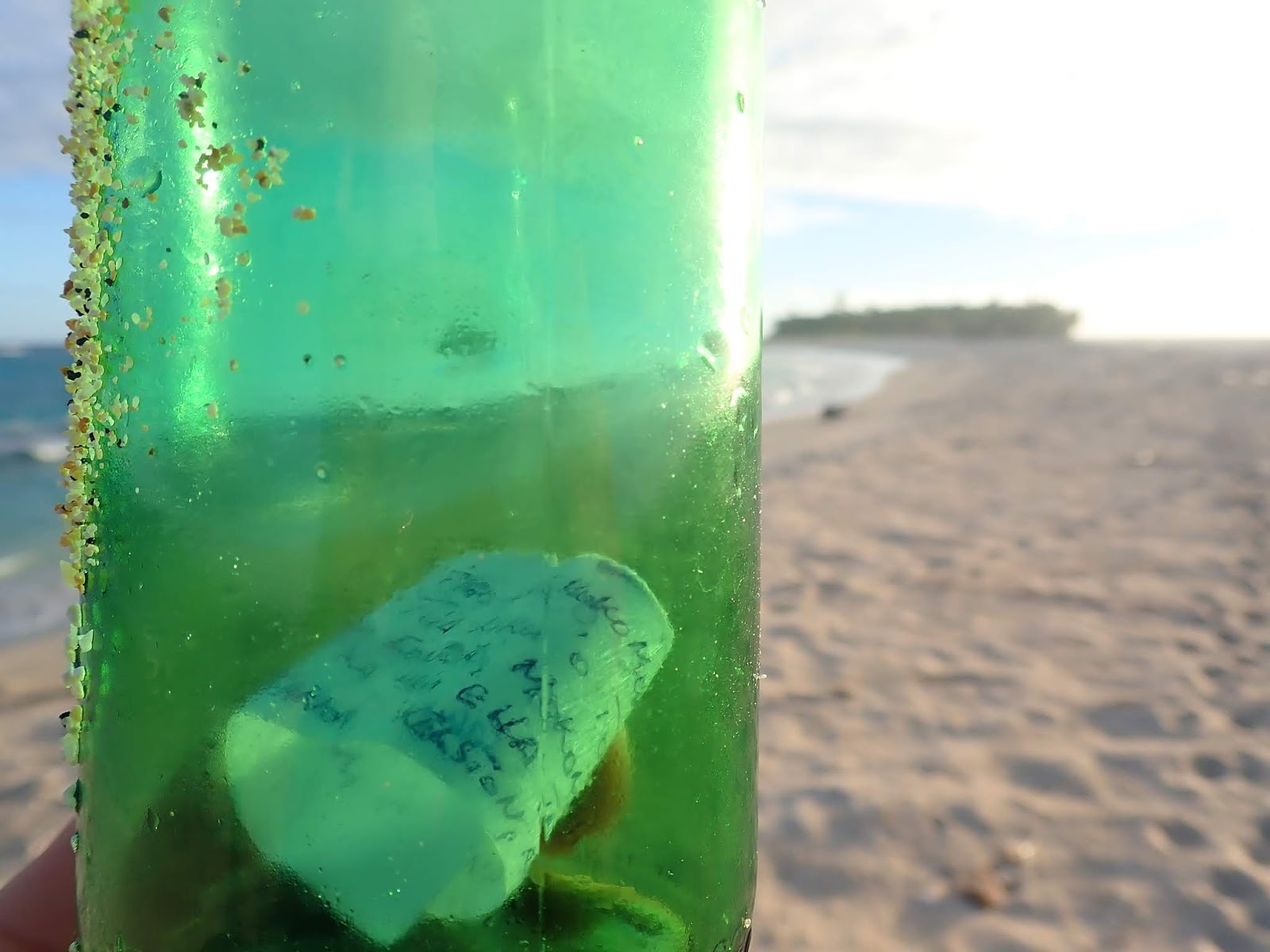
On the bright side, Max and the kids found a message in a bottle on one of their non-kiting excursions ashore, but it was written in Tongan, so it took us a while to get it translated.  When I finally asked some ladies in the market in Vava'u write it out in English for me, it turned out to be from someone in NZ, whom we will call at some point.  On one of our early nights at this anchorage, we were given a glimpse of the reason for the name of the islands: some Tongan men from Pangai (the capital of Ha'apai) were camped out for a couple of nights of spear-fishing (yes, nights – they said that the fish were slower and sleepier at night, and therefore easier to catch, and no, there was nothing scary in the water that they were afraid of -- I wasn't convinced that this would be my cup of tea!) and they showed us their coolers of fish that they were taking back to the market. Resting gently on a collection of average-sized fish was the largest lobster I have ever seen! After a few minutes of conversation, during which we learned that they came semi-regularly to this island to spearfish, in true Tongan style, they offered to share their catch with us. There was no refusing their gesture, and so we found ourselves with three fish, which fed us dinner that night and lunch the following day.


The third place we kited in the Ha'apai was also the most social: we had a great time kiting at Matafonua Lodge, where we anchored on the recommendation of our friends on SY Tika. With two resorts within walking distance, both owned by Darren and Nina, a couple of delightful former underwater documentary filmmakers who were very welcoming of yachties (despite what our guidebook said about the previous owner of the more up-scale Sandy Beaches) and whose kids were similar ages to ours, it was easy to spend days that turned into weeks with them! We came in July on our way north to Vava'u, and we returned in August to swim with whales with their guides.    

Matafonua was especially recommended as a kiting/windsurfing location, but ironically there was no wind for the first week. We had to content ourselves with snorkelling and paddleboarding in their beautiful aquarium lagoon, which was certainly not a hardship!  There are up to six leopard sharks resident in the pass north of the resort (we saw two regularly), and a spectacular coral garden just off their beach.  The leopard sharks are nocturnal, so they seemed quite oblivious to us when we swam near where they were sleeping at the bottom of the pass (although they clearly keep their sixth sense active, and darted away when Max swam down to get a close-up photo).  Some of the most beautiful, and shallow, snorkelling that we have seen is in the bay near Matafonua, where a colourful variety of coral and tiny fish could be found in only a few feet of water. Max was the family member who saw the most big fish, as he connected with some staff and guests who enjoyed spear-fishing, and was able to go out a few times on the nearby reefs (we were popular because we had our own dinghy!), although being close to a populated area, the really big fish were few and far between. A number of years ago, a big storm swept the sand from their beach and unearthed petroglyphs that we enjoyed investigating (which may indicate an ancient link between Tonga and Hawaii: http://www.jps.auckland.ac.nz/docs/Volume118/Volume%20118%20No%203/2%20Triangular%20men.pdf).

Lepoard Shark

Leopard Shark
As I mentioned earlier, we didn't meet a lot of kid boats this year, as we always seemed to be a little out of sync with the general migration: our friends who were doing a loop from NZ through the islands and back again didn't stay in Tonga as long as we did, and the Pacific Puddle Jump fleet arrived in Tonga towards the end of our sojourn (and mostly stayed in Vava'u when we were back in the Ha'apai, and in Tonga when we went on to Fiji), but our kids really enjoyed hanging out with the kids at Matafonua. We had movie nights, shared dinners, fudge-making, and various escapades pretty much every day that we were there. One Sunday afternoon, they invited Victoria and Johnathan to join their family and some guests on a snorkelling trip.  We found out later that most of the guests were expert/professional underwater photographers, and one of them took what has turned out to be one of my favourite photographs of Johnathan, showing him blowing bubble rings as he was taught a couple of years ago in Fiji by our friend Dave's daughter Tessa (SV Rewa).  It was fun to have a sense of reconnection to that Fiji visit after all this time!  (It was also a good reminder that kids have long memories and they are always learning).

Bubble rings !

---------------

Stay tuned for part three shortly ...

Thursday, 1 November 2018

Letter Home - Tonga - Part 1 of 5.

Here is the first in a series of Liz's recent letter home describing our time in Tonga.
----------------------------------


Hello!  

We spent almost three months enjoying the Ha'apai and Vava'u Groups in the Kingdom of Tonga, where celebration of the Royal Family neatly bookended our season: there was a holiday when we arrived for the King's birthday, and a holiday at the end for the birthday of the Crown Prince :)

While we were in Tonga, we had a bit of a summer holiday feeling on the boat, with less maintenance and chores, and more emphasis on exploring, kiting, swimming with whales, and meeting other kid boats.  For once, we did the things that *we* assume that *you* assume we do all the time!  

Given that it's now Hallowe'en, I feel a bit like I'm late with my stereotypical "what we did on our summer vacation" project ... but after daily notes while we were on passage, I thought it was high time for an update.  You'll want a big cuppa for this one, as it's admittedly long, but I thought you might like to know some of the stories behind the photos.

If you followed Max's updates on Yachts in Transit you would have noticed us travelling from the Ha'apai Group up to Vava'u, back again to the Ha'apai, then back to Vava'u before heading to Fiji.  When we cleared into Tongatapu, we were told that we could extend our 30-day visa in the Ha'apai.  Of course, you know what comes next: we arrived there and found that we could *not* extend our visa, and that we would need to go to Vava'u within 31 days.  The fines for overstaying made sure that we headed north with time in hand!  As it turned out, this was fortunate, as it meant that our return to the Ha'apai was during the height of the whale season; had we simply stayed longer at the beginning, we would have missed the majority of our whale experiences.  


One of the things we loved about the Ha'apai Group was the lack of other boats, so we were pretty happy that two of the first boats that we met had kids aboard: SV Forever had a 13-year-old boy with many of the same interests as Johnathan, while SV Kitenga had a seven-year-old boy, so there was lots of running around on the beach and playing with sticks !  

Five years after our last significant use of our First Aid kit, we were especially grateful that the 'Kitenga mum' was a nurse!  As I was finishing a sunset yoga practice ashore, a quiet but firm voice said, "Mom, it's time to go.  Benjamin has hurt his head."  Johnathan was just off the beach in the dinghy, and Victoria had come to fetch me.  When we arrived at Fluenta, I was surprised that the first thing I heard was laughter, but Max had Benjamin watching a cartoon and playing a video game while "applying pressure" to the place on his forehead where his "blood was leaking out". He had tripped while crossing the cockpit to greet the kids who were returning to Fluenta in Trickle, and he had hit his head on one of our main winches. He hit the top edge of the self-tailer track with enough force to make a 3/4" slice in his forehead and for the bottom edge to make a parallel groove on his skin 1/2" below.    Yikes. The moment he saw me, the tears began again with gusto.  


The kids and Max had already started him on every-10-minutes homeopathic Arnica, so I scooped him up to apply the other universal remedy of motherhood (i.e. nursing), and endeavoured to calm him back down.  Our friends from Kitenga were already planning to come over for the evening, but Max went and asked them to come over straight away, as this was the first time that we had needed to use our Steri-Strips, and I figured that we should solicit any help available!  The combination of the Steri-Strips and Johnathan being Benjamin's own personal comedian soon had Benjamin back in stitches, and once he was 'taped up' that was the last we saw of tears over his forehead.  

[An interesting side note is that he seemed to have a lower pain threshold for any minor bumps and scratches for a few weeks, but this now seems to have returned to normal.]  


The Steri-Strips took exactly two weeks to fall off, and Benjamin was quite fascinated to look at his forehead in the mirror several times a day to judge the progress of his skin at "knitting itself back together".  The number of times we have had to open our big medical kit has actually been quite small, but this is why we carry it!  Thankfully, the rest of our many evenings together with Kitenga were much more uneventful!

One of the things that I love about Victoria and Johnathan is that regardless of how much or how little time they have with new kids, they will find something in common and make the most of their time together.  Whenever possible, this will involve camping ashore, or at the very least building a structure out of palm fronds and a camp fire.  Time for s'mores is an added bonus.  They didn't end up camping with the kid boats in Ha'apai, but when we got to Vava'u, even though the overall pace of socializing moved a little faster, and we often only had a couple of nights together, they managed to fit in several camping expeditions.


One morning in Vava'u, while on our way to pick up fruits and vegetables at the market before going out to anchor, we stopped to say hello to a rare Canadian boat, and discovered that they had 15-year-old daughter.  Since they were also heading out overnight before leaving for the Ha'apai, and we wanted to visit their preferred anchorage eventually, we decided to change plans and join them.  We packed an entire season of visiting into one evening and one day with SV Element, with an impromptu potluck (somehow I knew that if we didn't include meal preparations in the grownups' plans, we might never feed our kids ...), beach day (complete with thatch hut and bonfire with sausages and s'mores), and moms' tea break; it was kind of fun to think that we might all meet up in Canada sometime after our return :)  Victoria was especially happy to meet a girl her own age, as we had only met boys for Johnathan and Benjamin to play with at that point in the season.


On another occasion, a boat hailed us on VHF because they had heard that we had kids (SV Beach Flea).  Imagine our delight when we invited them to join us at our anchorage and found out that they had coincidentally pulled in a few boats away the previous evening!  We spent an enjoyable couple of days together: the kids camped on the beach in a combination of tents and palm structures, while the parents enjoyed a potluck meal and socializing.  It was especially fun for Victoria and me to do mother-daughter yoga with Lisa and Abby, as they had recently been practicing with my dear friend Allison in Mexico!  It can certainly be a small, and well-connected cruising world :)


When we returned to Vava'u to clear out at the end of the season, one of the first things we heard was the sound of teenagers on the radio, and the very first morning we were at anchor in Neiafu, one of the moms excitedly stopped by in her dinghy because she had heard that we had a 14-year-old girl on board, to let us know that her daughter would stop by later.  Stop by, she did, with two kids from other boats in tow; we had gone from drought to flood with teenagers, and soon found ourselves swept up into the social scene of the fleet of kid-boats that had just come across the Pacific.  As usual, we didn't have long together, but the kids made the most of it with potlucks, dinghy raft-ups (our first in six years of cruising), and excursions ashore.  Unfortunately, by this time, we were gearing up to make the jump to Fiji, so as usual, we just had to enjoy our time with the other families while it lasted.  

These stories really give you the up-side and the down-side of cruising in a nutshell: we become quick at packing an intense friendship into a short period of time, but then we *have to* pack all our visiting into little bursts.  We are always saying Hello and Goodbye, and I have to say that even after over six years, it doesn't necessarily get any easier.  Thank goodness for email and online connectivity :)

------------------------

Stay tuned for the remaining parts over the next few days while we have internet.